
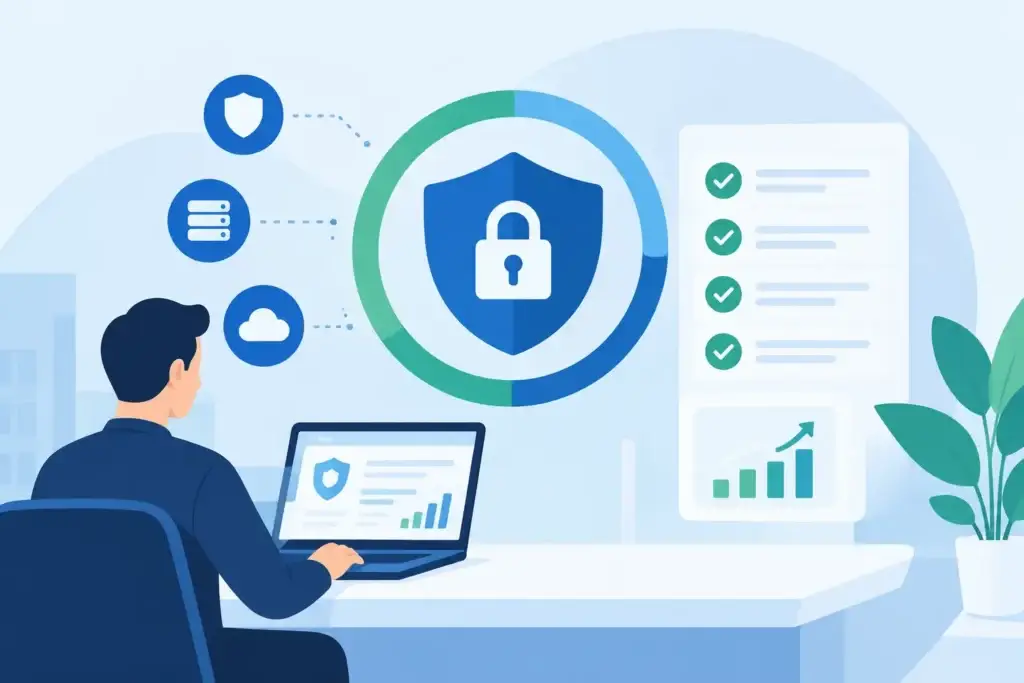
A cyber security assessment should not end with a score, a PDF or a spreadsheet full of unanswered questions. Its value lies in what happens next: understanding the gaps that matter, assigning ownership, improving controls and showing credible evidence of progress. Cyber security assessment software helps turn that process into a practical, ongoing discipline rather than a periodic compliance task.
For many organisations, the problem is not a lack of frameworks or advice. It is the gap between knowing what good looks like and managing the work required to get there. Evidence sits across systems, responsibilities are unclear, remediation actions lose momentum and senior leaders receive a snapshot that is already out of date.
The right platform creates a clearer operating model. It helps you understand where you stand, improve what needs attention and prove progress when customers, insurers, boards or regulators ask.
What cyber security assessment software should do
At its simplest, assessment software gives an organisation a structured way to measure its cyber security posture against a chosen set of requirements. That could be Cyber Essentials, Cyber Fundamentals, NIS2, ISO 27001-aligned controls or an internal security baseline.
But a useful platform should do more than present a questionnaire. A point-in-time assessment can identify gaps, but it cannot by itself reduce risk. To support real improvement, cyber security assessment software needs to connect assessment findings to evidence, actions, people and reporting.
That connection matters because cyber resilience is not owned by one person or achieved in a single project. IT teams may manage technical settings, business leaders may own risk decisions, compliance teams may coordinate evidence, and external providers may support implementation. Without a shared view of priorities and progress, each group can be working hard while the organisation remains unable to demonstrate control.
A well-designed system gives each audience what it needs. Executives need a clear view of material risks, priorities and progress. Security and IT teams need enough detail to validate controls and complete improvements. MSPs and cyber security providers need a consistent way to guide multiple customers without recreating the process each time.
Move beyond the annual assessment
Annual reviews still have a role. They create a formal checkpoint, support certification and can focus attention. The limitation is that technology, access, suppliers and threats change throughout the year. A status recorded six months ago may no longer reflect the environment a business operates today.
This is why assessment should be treated as a continuous cycle:
Understand. Assess the current position against relevant requirements and identify gaps based on evidence, not assumptions.
Improve. Turn gaps into prioritised actions with clear owners, due dates and a rationale that people can understand.
Prove. Maintain current evidence and report progress in a way that stands up to scrutiny.
The difference is operational. Instead of treating compliance as a deadline-led exercise, teams have a living view of what is complete, what is at risk and what needs a decision. This makes it easier to respond when a procurement questionnaire arrives, a customer requests assurance or a board asks whether security investment is making a measurable difference.
Evidence is where confidence is won or lost
Many organisations can describe their security arrangements. Fewer can quickly show that those arrangements are active, current and consistently applied. This is often where spreadsheets and shared folders begin to fail.
Evidence needs context. A policy document may support a requirement, but it does not always prove that a control is operating. A screenshot may be useful, but it can become stale. An exported configuration may be more reliable, yet it still needs to be linked to the relevant control and reviewed by the right person.
Good assessment software creates a clear relationship between a requirement, the evidence supporting it, the person responsible and any remaining action. Automated evidence collection and integrations can reduce manual effort for areas such as Microsoft 365 and Entra ID, while still allowing people to review the result and decide whether it meets the requirement.
That distinction is important. Automation can collect signals and flag potential issues. AI can explain technical findings and suggest priorities. People remain responsible for accepting evidence, making risk decisions and approving changes. AI advises. People decide.
Prioritisation matters more than the length of the gap list
A long list of findings is not an improvement plan. Resource-constrained businesses need to know which actions will reduce meaningful risk first, what effort is involved and who needs to act.
Prioritisation should consider more than a framework score. An exposed administrator account, weak multi-factor authentication coverage or an untested recovery process may deserve early attention because of its potential business impact. Other items may be valid improvements but less urgent, particularly where compensating controls already exist.
The answer will depend on the organisation. A business handling sensitive customer information, operating critical services or relying heavily on remote access will have different priorities from a small firm with a limited technology estate. Effective software gives a consistent method for assessing gaps while leaving room for informed judgement.
Each action should be specific enough to complete and verify. Assigning an item called improve access management is unlikely to produce a reliable outcome. Defining the systems in scope, the expected change, the owner, the due date and the evidence required creates accountability. It also makes progress visible before the next formal review.
Choose software that fits the way you work
The best cyber security assessment software is not necessarily the one with the longest control library. It is the one that helps your organisation maintain momentum without creating another administrative burden.
When evaluating options, look for four practical capabilities:
- Guided assessments that translate requirements into clear, relevant questions rather than unexplained control language.
- Evidence management that keeps proof connected to the requirement it supports, including automated collection where appropriate.
- Remediation workflows that assign ownership, track progress and make overdue or blocked actions visible.
- Reporting that gives technical teams detail while providing leaders with a credible business-level view of risk and improvement.
Framework mapping is also valuable for organisations working across more than one standard. The same technical safeguard may support Cyber Essentials, Cyber Fundamentals, NIS2 and ISO 27001-related requirements. Managing each framework in isolation creates duplicated evidence requests and inconsistent answers. Mapping controls helps teams reuse work appropriately while recognising that each framework may still require different proof or governance decisions.
For MSPs and providers, consistency is particularly valuable. A repeatable assessment and improvement process makes it easier to compare customers, demonstrate delivered value and identify where specialist support is needed. However, standardisation should not mean treating every customer identically. The platform should support a consistent method while allowing priorities to reflect each customer’s risk, sector and maturity.
Reporting should support decisions, not decorate meetings
Security reporting often fails in one of two ways. It is either so technical that senior leaders cannot act on it, or so high-level that it hides the work still required. Useful reporting bridges the two.
A management view should show current posture, the most significant gaps, improvement trends, overdue actions and decisions that need leadership support. It should answer practical questions: Are we improving? What remains exposed? Who owns the next steps? What evidence supports our position?
The technical detail should remain available underneath that view. Teams need to see control-level findings, attached evidence, action history and responsibility. This traceability makes reports more trustworthy because progress is not simply asserted. It is backed up with evidence and an auditable record of action.
Cyber Fundamentals AI is designed around this continuous model, bringing assessments, evidence, remediation, responsibilities and reporting into one workspace. Its AI Virtual CISO helps users interpret findings and prepare clear management guidance, while keeping decisions with the people accountable for them.
Make assessment part of normal operations
Software alone will not improve cyber resilience. The organisation still needs named owners, time to complete actions and leadership willing to make risk decisions. The software’s role is to make those responsibilities visible and manageable.
Start with the framework or baseline most relevant to your business needs. Complete an honest assessment, attach the evidence you already have and identify the gaps that present the clearest risk. Then set a review rhythm that reflects change in your environment, not just an annual compliance date.
The goal is not a perfect score for its own sake. It is a current, defensible understanding of cyber security, a practical plan for improvement and the ability to show others that progress is real. When assessment becomes part of how the business operates, cyber resilience becomes easier to manage and much easier to prove.