
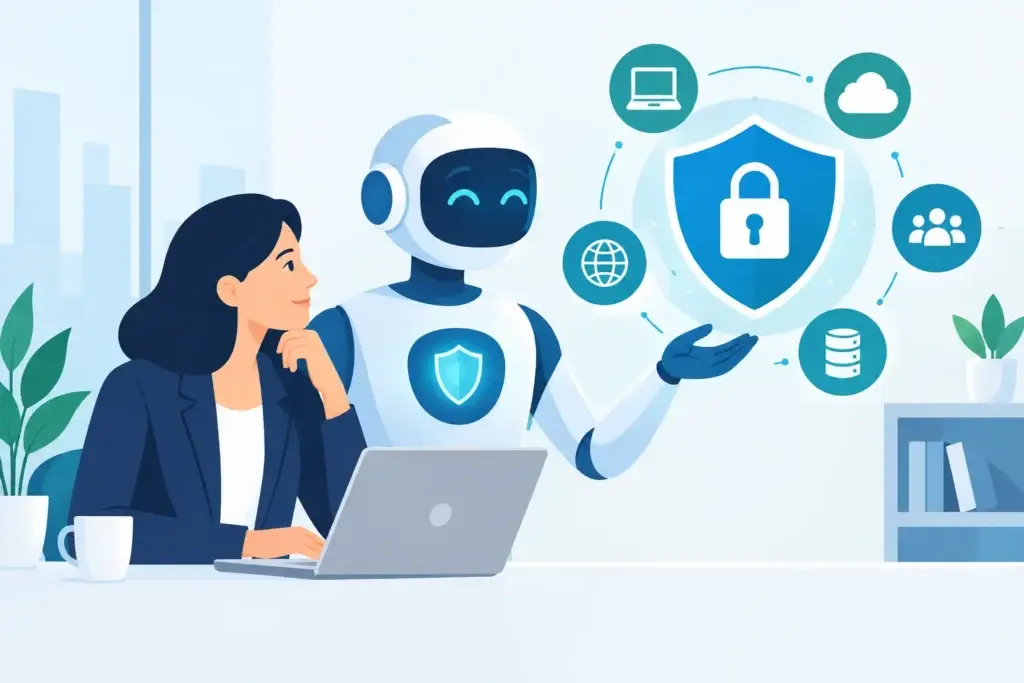
A customer security questionnaire lands in an inbox. Your insurer asks for proof of controls. A director wants to know whether the business is exposed. For many smaller organisations, each request creates the same scramble: find the latest assessment, chase evidence and work out which issues genuinely need attention. An AI virtual CISO for SMEs can change that pattern by turning scattered technical information into clear priorities, practical actions and management-ready guidance.
It is not a substitute for accountable leadership, skilled IT teams or specialist advice where the risk demands it. It is a way to give those people better context, a clearer route forward and a more current view of cyber resilience.
Why SMEs need clearer cyber leadership
A large organisation may have a Chief Information Security Officer, governance teams and dedicated security operations. Most SMEs do not. Cybersecurity responsibilities often sit with an IT manager, a managed service provider, a compliance lead or a business owner already balancing several roles.
That does not reduce the expectations placed on the business. Customers want assurance. Procurement teams request evidence. Insurers ask focused questions. Frameworks such as Cyber Essentials, Cyber Fundamentals and NIS2 set out requirements that must be understood and managed. The challenge is not simply collecting more information. It is deciding what it means and what to do next.
A yearly assessment can provide a useful snapshot, but risk does not stand still for twelve months. New users join, software changes, devices are replaced and suppliers evolve. Evidence that was sufficient at the point of assessment can quickly become incomplete or out of date. Spreadsheets and shared folders make this harder, particularly when no one can easily see who owns an action or whether it has been completed.
Effective cyber leadership for an SME therefore needs to be continuous. Know where you stand. Know what to fix next. Back progress up with evidence.
What an AI virtual CISO for SMEs should do
The best AI virtual CISO capability does not make unexplained decisions or produce generic advice that ignores the organisation’s context. It acts as a guide across the cyber improvement process, helping people interpret findings, understand the business relevance and prioritise action.
Translate technical findings into business decisions
A technical gap may be described in terms of account configuration, device management or access control. A director needs to understand whether that gap could lead to fraud, service disruption, data exposure or difficulty meeting a contractual commitment.
An AI Virtual CISO should bridge that gap in language that makes sense to both audiences. IT and security teams still need sufficient detail to act. Senior leaders need a concise explanation of the risk, the recommended response, the owner and the consequences of delay. This creates a shared view rather than two separate conversations.
Prioritise rather than overwhelm
Most organisations can identify more possible improvements than they can complete at once. Treating every finding as equally urgent leads to stalled programmes and unclear accountability.
Priority should reflect the likely impact on the business, the exposure created, the requirements that apply and the effort needed to reduce the risk. A missing multi-factor authentication control protecting administrator accounts will usually need more immediate attention than a documentation improvement with limited operational effect. Context matters, however. A smaller issue may become urgent when it affects a critical customer commitment or a known regulatory obligation.
AI can help organise that judgement and explain its reasoning. People should remain responsible for accepting risk, allocating budget and deciding whether a recommendation is appropriate for their organisation. AI advises. People decide.
Connect evidence, actions and progress
Advice alone does not prove anything. An organisation needs a reliable way to show its current position, the evidence supporting it, the gaps identified and the work underway to address them.
That means linking assessments to relevant evidence, assigning remediation actions to named owners and tracking progress over time. When a customer, board or auditor asks for assurance, the business should not have to reconstruct the story from emails and old files. It should be able to show what was assessed, what changed, what remains open and why.
From compliance event to continuous improvement
The value of an AI virtual CISO is greatest when it works as part of an ongoing improvement process, not as a chatbot added at the end of an assessment.
Start with a structured understanding of the current posture. Guided assessments help an organisation establish what controls are in place and where there are gaps. Integrations and automated evidence collection can reduce manual effort, particularly for common sources such as Microsoft 365 and Entra ID. This also helps avoid a familiar problem: evidence that looks convincing but no longer reflects the live environment.
Next, turn the findings into an improvement plan. Each action needs a clear description, proportionate priority, named owner and target date. Where a requirement maps across more than one framework, the organisation should not have to repeat the same work. Control mapping helps connect activity across Cyber Fundamentals, Cyber Essentials, NIS2 and ISO 27001 requirements, while keeping the evidence and decision trail understandable.
Finally, review progress regularly. This is where AI guidance can be especially useful. It can help explain what has improved, flag areas needing attention and prepare clear reporting for management. A leadership report should not be a long list of technical settings. It should make the current level of resilience, material risks, overdue actions and evidence position visible at a glance.
Cyber Fundamentals AI brings these activities into one workspace, combining assessments, evidence, remediation, responsibilities and reporting with AI-led guidance. The aim is not to automate accountability away. It is to make accountable decisions easier to take and easier to demonstrate.
Where AI guidance needs human judgement
There is a temptation to see AI as an answer to the shortage of cyber skills. It can increase the capacity of a small team, but it does not remove the need for judgement.
For example, an AI recommendation may identify that access permissions should be reviewed. A manager still needs to understand which people require access for their role, what disruption a change could cause and how to handle exceptions. Similarly, a system may highlight a policy gap, but leaders must decide whether the policy reflects actual working practices and whether people have been trained to follow it.
Human review is particularly important when decisions affect legal obligations, customer contracts, incident response, significant investment or risk acceptance. The quality of AI guidance also depends on the quality and currency of the information available. Incomplete assessments, stale evidence and poorly defined ownership will lead to weaker outputs.
The practical test is simple: does the guidance help the organisation make a better, traceable decision? If it cannot show the basis for its recommendation, the evidence behind it or the action it expects, it is adding noise rather than control.
Questions to ask before adopting an AI virtual CISO
For SMEs and the MSPs supporting them, the right approach should fit the way work is actually managed. It should support multiple levels of expertise without hiding the detail from those who need it.
Look for an approach that can answer four questions clearly. First, can it show the current cyber posture rather than only a historic score? Second, can it connect findings to prioritised actions with accountable owners? Third, can it retain evidence and show how requirements map across relevant frameworks? Fourth, can it produce reporting that a non-technical leader can use without losing the underlying detail?
Security and privacy also need proper consideration. Understand what information is processed, how it is protected, who can access it and how AI-generated guidance is governed. This is not administrative caution for its own sake. The platform helping manage cyber risk must itself support trustworthy ways of working.
For MSPs, consistency is another deciding factor. A shared method for assessing customers, assigning improvement actions and reporting progress makes services easier to deliver at scale. It should still allow recommendations to reflect the individual customer’s systems, obligations and appetite for risk.
Make progress visible
Cybersecurity becomes manageable when it is treated as a series of visible, owned improvements rather than an occasional rush to pass an assessment. An AI virtual CISO can give SMEs a practical guide through that work: interpreting the evidence, focusing attention and communicating clearly with decision-makers.
The goal is not a perfect score or a folder full of policies. It is a current understanding of risk, practical action where it matters most and credible proof that cyber resilience is improving.